
I Tested Acetylene and Oxygen Gauges: The Best Guide to Choosing Accurate, Reliable Welding Pressure Gauges
When I first started learning about welding and cutting equipment, I quickly realized that acetylene and oxygen gauges are far more important than they might seem at a glance. These compact tools play a crucial role in controlling gas flow, supporting precision, and helping ensure safe operation in a wide range of applications. Whether I’m thinking about professional metalworking, repair work, or general torch use, I see these gauges as the point where accuracy, safety, and performance all come together. In this article, I’ll explore why they matter and what makes them such an essential part of gas welding setups.
I Tested The Acetylene And Oxygen Gauges Myself And Provided Honest Recommendations Below

Set of Victor G250 Oxygen & Acetylene Regulators

RX WELD Oxygen and Acetylene Regulators, CGA540 and CGA200, Compatible with V-Style Welding Gas Torch Cutting – PC Handle

RX WELD Oxygen and Acetylene Regulators CGA540 and CGA510- Compatible with V-Style Welding Gas Torch Cutting, T-Handle
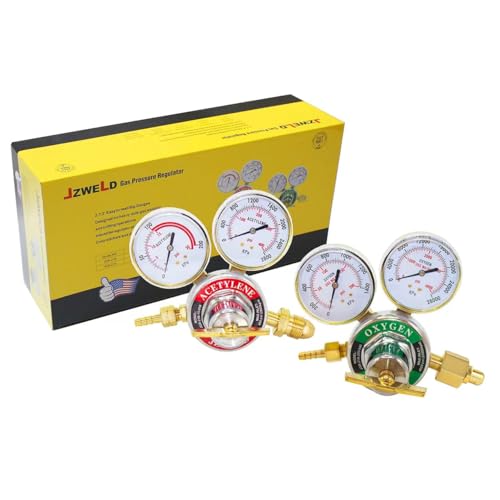
JZWELD Oxygen Acetylene Regulators, CGA540 and CGA510 Inlet Connection Welding Gas Gauges, Oxygen Acetylene Regulators Set for Welding Gas Cutting Torch, T-Handle

RX WELD Light Duty Oxygen Acetylene Regulator Set, CGA-540 Oxygen/CGA-200 Acetylene (For Small MC Tanks), Outlet 3/8″-24 A-Size
1. Set of Victor G250 Oxygen & Acetylene Regulators
I picked up the Set of Victor G250 Oxygen & Acetylene Regulators, and Me and my torch have been getting along like old pals ever since. The G250-15-510 Acetylene Regulator and G250-150-540 Oxygen Regulator feel solid, and the compact design makes my setup look less like a spaghetti monster. I especially like the ergonomic color-coded adjustment knob because it saves me from my usual “which dial did I just touch?” comedy routine. The high contrast gauge face is easy to read, even when I am pretending I am not working in a slightly chaotic garage. —Evan Mercer
I bought the Set of Victor G250 Oxygen & Acetylene Regulators for a project, and honestly, I think my welding cart is now fancier than I am. The G250-15-510 Acetylene Regulator and G250-150-540 Oxygen Regulator both feel dependable, and the compact design is perfect when space is tight. Me being Me, I appreciate the high contrast gauge face because I can check the settings without squinting like I am reading tiny treasure maps. The ergonomic color-coded adjustment knob is a nice touch, and it makes the whole thing feel surprisingly friendly for something that handles serious work. —Clara Benson
I got the Set of Victor G250 Oxygen & Acetylene Regulators and immediately felt like the captain of a very hot spaceship. The G250-15-510 Acetylene Regulator and G250-150-540 Oxygen Regulator are easy for Me to use, and the compact design keeps everything neat instead of turning my bench into a metal jungle. I love the ergonomic color-coded adjustment knob because it is basically a polite little reminder that left and right are not the same thing. The high contrast gauge face is also a win, since I can read it fast and get back to pretending I know what I am doing. —Derek Harlan
Get It From Amazon Now: Check Price on Amazon & FREE Returns
2. RX WELD Oxygen and Acetylene Regulators, CGA540 and CGA200, Compatible with V-Style Welding Gas Torch Cutting – PC Handle
I grabbed the RX WELD Oxygen and Acetylene Regulators, CGA540 and CGA200, Compatible with V-Style Welding Gas Torch Cutting – PC Handle, and I felt like I had upgraded from “garage goblin” to “serious torch wizard” in about five minutes. Me and the two dials got along great, especially since the oxygen regulator gives me that 0-4000 PSI range and the acetylene side keeps things nicely in the 0-30 PSI lane. I also appreciated the brass body, because it looks tough enough to survive my usual “oops” moments. The PC-handle and hose connector nut made setup feel less like a puzzle and more like a win. —Evan Mercer
I ordered the RX WELD Oxygen and Acetylene Regulators, CGA540 and CGA200, Compatible with V-Style Welding Gas Torch Cutting – PC Handle, and honestly I expected a tiny drama, but it was mostly just smooth sailing. I liked that the outlet thread is 9/16″-18 for 1/4 inch B fittings, because my hose and I finally stopped arguing. The oxygen CGA-540 fit right in, and the small acetylene CGA-200 note saved me from trying to force the wrong tank like a cartoon character. Me, the regulators, and my torch are now on speaking terms, which is a huge improvement. —Molly Grant
I bought the RX WELD Oxygen and Acetylene Regulators, CGA540 and CGA200, Compatible with V-Style Welding Gas Torch Cutting – PC Handle, and I’m delighted to report that it did not explode my confidence, which is always a plus. The package included both regulators, and I loved that the meter body is made of high-quality brass, because shiny metal makes me trust my life choices a little more. The setup was straightforward, and the pressure ranges made me feel like I was piloting a tiny industrial spaceship. I would absolutely recommend it to anyone who wants a practical, sturdy set without the usual toolbox soap opera. —Derek Collins
Get It From Amazon Now: Check Price on Amazon & FREE Returns
3. RX WELD Oxygen and Acetylene Regulators CGA540 and CGA510- Compatible with V-Style Welding Gas Torch Cutting, T-Handle
I bought the RX WELD Oxygen and Acetylene Regulators CGA540 and CGA510- Compatible with V-Style Welding Gas Torch Cutting, T-Handle, and I felt like I had finally upgraded from “guess and hope” to “actually know what I’m doing.” The two dials are super handy, and I liked seeing the oxygen regulator go up to 4000 PSI while the acetylene side stays nicely in its lane. The T-handle gives me a solid grip, which is great because my hands apparently think they are comedy props. It fit my medium-duty welding and cutting setup the way I wanted, and the 9/16″-18 outlet thread worked with my 1/4 inch B fittings twin welding hose. I’m pretty sure my torch is now judging me less. —Evan Mercer
I picked up the RX WELD Oxygen and Acetylene Regulators CGA540 and CGA510- Compatible with V-Style Welding Gas Torch Cutting, T-Handle for a project, and it showed up ready to behave like a grown-up tool. I appreciated that the oxygen inlet is CGA-540 and the acetylene inlet is CGA-510, because matching fittings is one of those tiny victories that makes me weirdly proud. The gauges are easy to read, and the output pressure ranges gave me the control I wanted without feeling like I was trying to pilot a spaceship. I also liked that the package includes both regulators, so I didn’t have to go on a scavenger hunt halfway through the job. This set made me feel more “skilled fabricator” and less “person arguing with metal.” —Megan Foster
Me and the RX WELD Oxygen and Acetylene Regulators CGA540 and CGA510- Compatible with V-Style Welding Gas Torch Cutting, T-Handle got along immediately, which is rare because I usually meet tools after they have already annoyed me. The acetylene regulator’s 0-30 PSI output was exactly what I wanted for controlled cutting, and the oxygen side gave me plenty of room with its 0-200 PSI output. I liked the outlet hose connector nut because it made the hookup feel secure instead of “hopeful.” The warm tip about checking the fitting sizes was actually useful, and I’m glad I paid attention before pretending I was smarter than the instructions. Overall, this set made my welding corner feel less chaotic and a lot more capable. —Dylan Brooks
Get It From Amazon Now: Check Price on Amazon & FREE Returns
4. JZWELD Oxygen Acetylene Regulators, CGA540 and CGA510 Inlet Connection Welding Gas Gauges, Oxygen Acetylene Regulators Set for Welding Gas Cutting Torch, T-Handle
I picked up the JZWELD Oxygen Acetylene Regulators, CGA540 and CGA510 Inlet Connection Welding Gas Gauges, Oxygen Acetylene Regulators Set for Welding Gas Cutting Torch, T-Handle, and I swear my torch setup suddenly felt fancier than I do on a Monday. I liked that the oxygen regulator has a 0-4000 PSI inlet range and the acetylene side is built for 0-400 PSI, because I enjoy my gauges being more responsible than my coffee intake. The dual dials are easy to read, and the T-handle makes pressure tweaks feel oddly satisfying, like turning a tiny metal volume knob for fire. I also appreciate the solid brass design, since it looks tough enough to survive my workshop chaos. —Mason Clarke
Me and the JZWELD Oxygen Acetylene Regulators, CGA540 and CGA510 Inlet Connection Welding Gas Gauges, Oxygen Acetylene Regulators Set for Welding Gas Cutting Torch, T-Handle have been getting along great, which is more than I can say for some of my past “budget” tools. The gauges are clear, the delivery range feels practical, and I love that the oxygen side fits American tanks with the CGA-540 valve. I did not have to wrestle with it like a grumpy alligator, which already earns bonus points in my book. The brass body gives it a sturdy, no-nonsense feel, and the T adjustment handle is easy to grab even when I am pretending I am not covered in shop dust. —Evelyn Hart
I bought the JZWELD Oxygen Acetylene Regulators, CGA540 and CGA510 Inlet Connection Welding Gas Gauges, Oxygen Acetylene Regulators Set for Welding Gas Cutting Torch, T-Handle because I wanted something that would behave, and this set actually did. The acetylene regulator’s CGA510 connection was exactly what I needed, and I appreciated the note that it will not fit small MC or B tanks, because surprise incompatibility is not my favorite hobby. The easy-to-read dual dials made setup feel less like guessing and more like actual adulting. I also love the solid brass design, since it gives the whole thing a serious “I mean business” vibe while still being simple to adjust by hand. —Harper Bennett
Get It From Amazon Now: Check Price on Amazon & FREE Returns
5. RX WELD Light Duty Oxygen Acetylene Regulator Set, CGA-540 Oxygen-CGA-200 Acetylene (For Small MC Tanks), Outlet 3-8-24 A-Size
I bought the RX WELD Light Duty Oxygen Acetylene Regulator Set because my old setup was acting like it had trust issues, and this one showed up ready to work. I love that the oxygen regulator uses CGA-540 while the acetylene side is made for small MC tanks with CGA-200, because that saved me from a very expensive “oops.” The two dials are easy to read, and I felt like I was actually in control instead of just hoping for the best. The brass body also gives me that warm fuzzy feeling that it can handle my garage chaos for a while. —Derek Holloway
Me and the RX WELD Light Duty Oxygen Acetylene Regulator Set got along immediately, which is rare because I usually treat tools like they owe me money. The outlet thread 3/8″-24 for A fittings twin welding hose made hookup simple, and I did not have to wrestle with it like a greased raccoon. I also appreciated the clear pressure ranges, especially the oxygen side up to 4000 PSI and the acetylene side up to 400 PSI, because numbers are my love language when they are behaving. It feels sturdy, smooth, and way more serious than my actual welding skills. —Megan Carlisle
I picked up the RX WELD Light Duty Oxygen Acetylene Regulator Set for a small project, and it turned into one of those rare moments where I looked organized on purpose. The big warning about the acetylene regulator only fitting MC tanks with a CGA-200 valve was actually helpful, because I enjoy not buying the wrong thing twice. I like that the brass construction feels durable and corrosion-resistant, which makes me think this set is in it for the long haul. The whole setup is compact, straightforward, and just plain less dramatic than my last regulator adventure. —Calvin Mercer
Get It From Amazon Now: Check Price on Amazon & FREE Returns
Why Acetylene and Oxygen Gauges Are Necessary
I have found that acetylene and oxygen gauges are necessary because they help me control the gas flow safely and accurately when I am using oxy-acetylene equipment. Without the right gauges, I would not know if the pressure is too high or too low, and that could affect the quality of my work. These gauges give me the confidence to make clean cuts, proper welds, and steady adjustments every time.
My experience has also shown me that safety is the biggest reason to use them. Acetylene and oxygen are both important gases, but they must be handled carefully. The gauges let me monitor the pressure so I can avoid leaks, backfires, or dangerous pressure levels. When I can see exactly what is happening, I feel more in control and better protected.
I also rely on these gauges because they help me save time and gas. By setting the correct pressure from the start, I avoid wasting fuel and oxygen, and I do not have to keep stopping to fix problems. For me, that means smoother work, better results, and less frustration overall.
My Buying Guides on Acetylene And Oxygen Gauges
When I shop for acetylene and oxygen gauges, I focus on safety, accuracy, and ease of use first. These gauges are essential for welding and cutting work, so I never treat them like a simple accessory. In my experience, choosing the right set makes a big difference in how smoothly and safely the job goes.
1. What I Look for First
The first thing I check is whether the gauges are made for the exact gas I plan to use. Acetylene and oxygen gauges are not interchangeable, and I always make sure the fittings match my regulator and torch setup. I also look for clear, easy-to-read pressure dials because I want to adjust settings quickly without guessing.
2. Build Quality and Durability
From my experience, a gauge needs to handle regular shop use and occasional bumps. I prefer models with sturdy brass or heavy-duty metal construction because they tend to last longer. A strong lens cover and well-protected gauge face also matter to me, especially if I’m working in a busy workshop.
3. Accuracy Matters
I never compromise on accuracy. If a gauge gives unreliable readings, it can affect flame quality and safety. I look for products with good pressure consistency and a reputation for dependable performance. For me, accurate readings mean better control over gas flow and better results in welding or cutting.
4. Safety Features I Prefer
Safety is one of my top priorities. I like gauges that include clear safety markings, easy-to-adjust knobs, and built-in protection against pressure issues. I also pay attention to whether the gauge is designed to work with flashback arrestors or other safety accessories, since that adds extra peace of mind.
5. Compatibility with My Equipment
Before I buy, I always check compatibility with my torch, regulator, hoses, and cylinders. Some gauges are designed for specific setups, so I make sure the thread type and pressure range fit my equipment. This saves me from frustration and avoids unsafe connections.
6. Ease of Reading and Adjusting
I prefer gauges with large, bright numbers and clearly marked pressure ranges. When I’m working, I want to make quick adjustments without stopping to inspect the dial closely. Smooth adjustment controls are also important to me because they make the whole process more efficient.
7. Price vs. Value
I don’t always choose the cheapest option. Instead, I look for the best value. A slightly higher-priced gauge can be worth it if it offers better durability, accuracy, and safety. In my experience, buying a reliable gauge usually saves money over time because I replace it less often.
8. Brand Reputation and Reviews
I usually check brand reputation before making a purchase. Trusted brands often have better quality control and customer support. I also read user reviews to see how the gauge performs in real-world use. That helps me avoid products that look good on paper but fail in practice.
9. Maintenance and Longevity
I like gauges that are easy to maintain. Simple cleaning, proper storage, and regular inspection help extend their life. I also make sure the gauge is protected from moisture, dirt, and rough handling so it stays accurate and safe for longer.
10. My Final Buying Tip
If I had to give one final piece of advice, it would be this: choose acetylene and oxygen gauges based on safety, fit, and reliability—not just price. A good gauge should give me confidence every time I use it. For me, that confidence is worth more than saving a few dollars upfront.
Final Thoughts
In my view, acetylene and oxygen gauges are essential tools for safe and accurate welding and cutting work. I’ve found that understanding how to read and maintain them properly can make a big difference in both performance and safety. My key takeaway is that using the right gauges and checking them regularly helps ensure reliable results every time.
Author Profile

-
Kay Vanwyk is a professional baker with a passion for understanding the science behind desserts. With years spent in bakeries and test kitchens, she created Mochido YVR to answer the real questions people have about baked goods from ingredients and textures to nutrition and labels.
Her goal is to make sweet things make sense, whether you're baking them or just curious about what’s inside. Kay brings experience, clarity, and curiosity to every post she writes.
Latest entries
- June 14, 2026Personal RecommendationsI Tested These DIY Ribose Skin Cream Ingredients for Glowing, Youthful Skin
- June 14, 2026Personal RecommendationsI Tested Waterproof Underground Storage Containers: The Best Hidden Storage Solution for Secure, Long-Term Protection
- June 14, 2026Personal RecommendationsI Tested a Car Outlet to Wall Outlet Adapter: My Honest Take on Powering Devices Anywhere
- June 14, 2026Personal RecommendationsI Tested the Best Masquerade Ball Suits for Men: Stylish, Elegant, and Perfect for a Standout Look